

The Liverpool Telescope
A fully robotic 2-metre telescope on La Palma
Introduction
The Liverpool Telescope, or "LT", is a fully robotic astronomical telescope owned and operated by the Astrophysics Research Institute of Liverpool John Moores University in north west England. It was designed and built by Telescope Technologies Limited — a spin-off company of the university — as the prototype of their production-line range of two-metre class telescopes. The LT was therefore the "first off the line".
Operational since 2004, it specialises in the rapid, automated follow-up of transient and variable objects, monitoring sources on timescales from seconds to years.
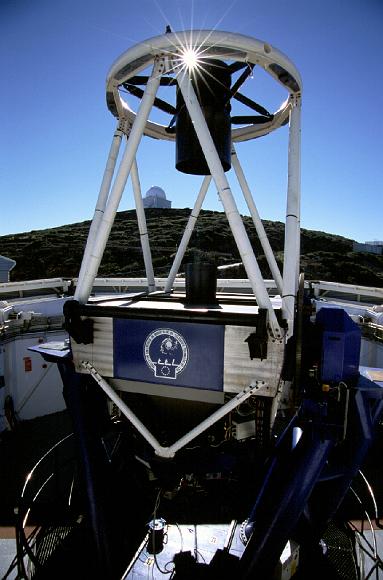
Optical Design & Instrumentation
The telescope is a two-metre Cassegrain reflector with Ritchey-Chrétien hyperbolic optics on an alt-azimuth mount. Up to nine instruments can be mounted at the Cassegrain focus — one in the "straight-through" position and eight more on side ports, reached by a rotating "science fold" tertiary mirror. Over the years a wide variety of optical and near-infrared imagers, spectrographs and polarimeters have been mounted on the LT.
Instruments in Operation
Instrument details are being updated. Please check back soon.
Technical Specifications
Optics
- Design
- Ritchey-Chrétien Cassegrain
- Primary
- 2.0 m, f/3
- Secondary
- 0.62 m, movable
- Cassegrain
- f/10
- Field
- 40 arcmin
Mount & Tracking
- Mount
- Alt-azimuth
- Structure
- Serrurier truss
- Slew rate
- 2°/sec, all axes
- Altitude
- 21–88°
- Autoguider
- Andor DV435
Enclosure
- Type
- Clamshell, 2 shutters
- Bearings
- Hydrostatic
- Mirror support
- Pneumatic, 1.35 t
- Opening
- ~3 minutes
Site
- Observatory
- Roque de los Muchachos
- Island
- La Palma
- Latitude
- 28.7624° N
- Longitude
- 17.8792° W
- Altitude
- 2363 m
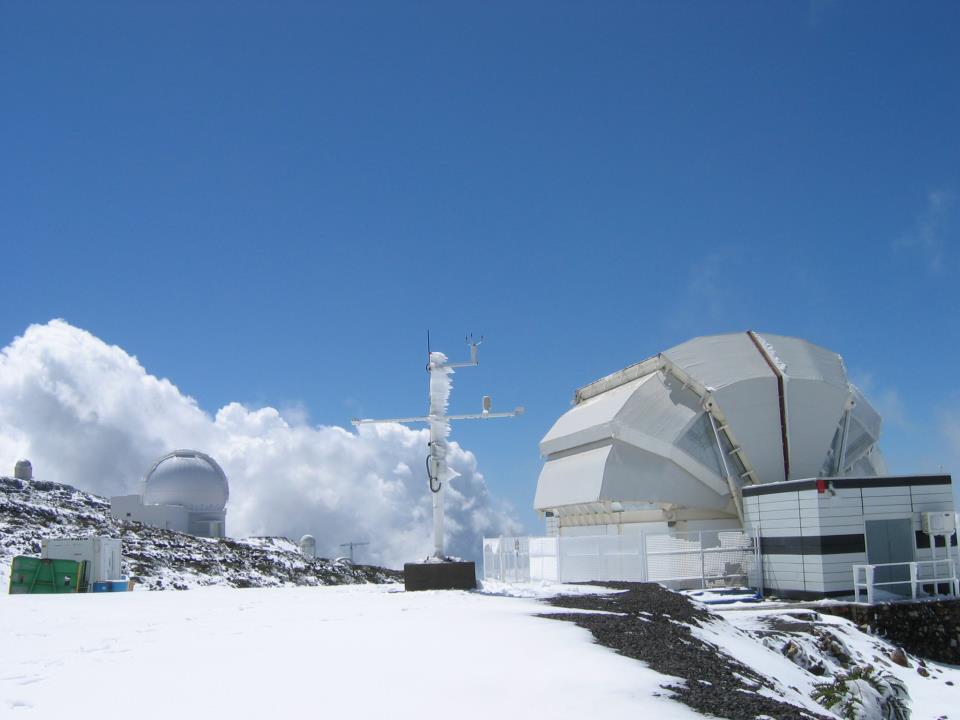
The Clamshell Building
The part of the observatory housing the telescope — the "enclosure" — is a novel clamshell design that opens in two halves from the top down (think of a doctor's bag). Each shutter is made up of three separate portals.
This gives the telescope an unencumbered view of the entire sky and dramatically reduces the time it takes to slew to a new target — the enclosure opens in roughly three minutes — which is essential for catching fast-fading transients.
A Subtropical Location
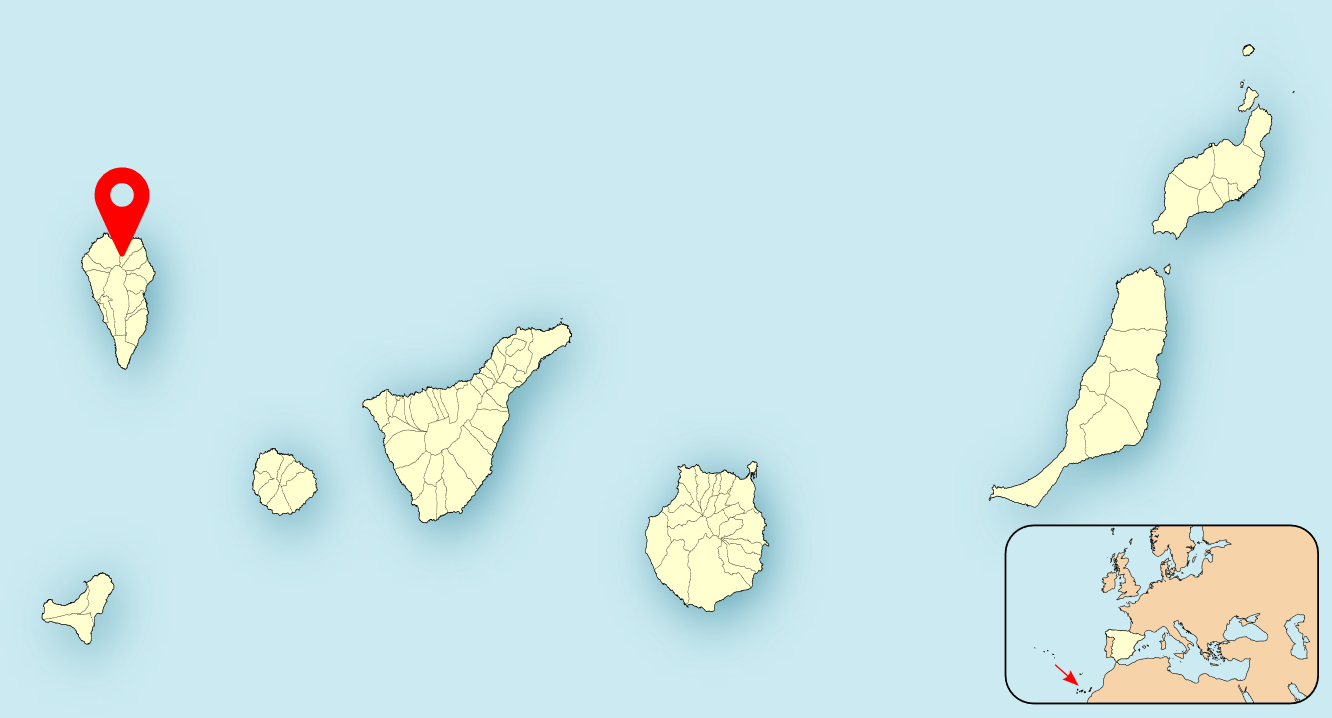
Contrary to its name, the Liverpool Telescope is not in Liverpool but in the Canary Islands. It is sited at the international Observatorio del Roque de los Muchachos on the summit of La Palma, westernmost of the Canaries, some 200 km off the coast of north-west Africa.
This is one of the best astronomical sites in the world: the remoteness of the island, the lack of urban development and a local agreement to restrict artificial light pollution all ensure the continued quality of the night sky.
The LT shares the observatory with much larger telescopes, including the 4.2 m William Herschel Telescope, the 3.6 m Italian Galileo National Telescope and the 10 m Spanish GranTeCan — but the LT is the only one that is fully robotic.
Fully Autonomous
When we say "robotic", we do not mean the telescope is operated by remote control. The LT is fully autonomous — it operates by itself, as if it had an "astronomer" of its own. For this reason it has been described as somewhat like a "space probe on the ground". Should the need arise, the team can take manual control remotely from the UK, or locally with trained personnel on La Palma.
Robotic Control System
The RCS acts as a "robot user", running the telescope with no human at the controls and making every observing decision itself.
Dispatch Scheduler
Candidate observations are scored against priority, target elevation, seeing, sky brightness, airmass and timing — picking the one best matched to current conditions.
Target of Opportunity
A priority mode lets external alerts (e.g. GCN triggers) override the schedule and take control — catching transients within seconds.
Continuous weather and sky monitoring can suspend observing to protect the telescope, and the system is designed to be fault-tolerant for long periods of unattended operation.
Scientific Goals
The LT concentrates on meeting specific scientific goals well suited to a robotic telescope.
Rapid Reaction
Rapid robotic reaction to unpredictable phenomena and their systematic follow-up.
Surveys & Follow-up
Small-scale surveys and follow-up of serendipitous sources.
Variability Monitoring
Monitoring of variable objects on all timescales — from seconds to years.
Coordinated Observations
Simultaneous coordinated observations with other ground- and space-based facilities.
Ready to apply for observing time?
Submit a Phase 1 proposal through the LT Science Operations and Data Centre.
Phase 1 Proposals LT Main Website